Most nursing program directors we speak with are no longer asking whether VR simulation works. They’re asking how to demonstrate its impact to accreditors, curriculum committees, and funding organizations.
A few years ago, that was a difficult question to answer. Today, it’s becoming easier.
Grant-funded accelerated BSN programs are increasingly designing VR pilots to generate publishable evidence. They’re collecting structured outcomes, presenting findings at conferences, and contributing to peer-reviewed research. The evidence base for VR in accelerated nursing education is now expanding. Just a few years ago, there was far less published research available.
For accelerated programs, this is particularly important. Compressed timelines, limited clinical placements, and high-acuity learning leave little room for educational activities that cannot demonstrate their value. While VR offers clear advantages in this environment, programs that collect evidence from their own learners are in a stronger position to evaluate its role within their curriculum and communicate those findings to external stakeholders.
How a pilot is designed also matters.
Programs that build outcomes collection into their implementation from the beginning will have evidence that reflects their own students, curriculum, and clinical context. Programs that add evaluation later may find it more difficult to answer questions about impact or compare results over time.
The method of delivery is another consideration.
Outcomes from instructor-led VR sessions can provide valuable evidence. However, they also reflect a model in which faculty are involved in every learning experience. For programs where faculty capacity is already limited, it is worth considering how self-directed simulation affects both learning opportunities and the evidence that is collected.
When learners can complete scenarios independently, receive immediate feedback, and repeat cases as needed, programs can expand access to practice while continuing to collect consistent outcomes data. That evidence reflects a model that can scale without increasing faculty time for every session.
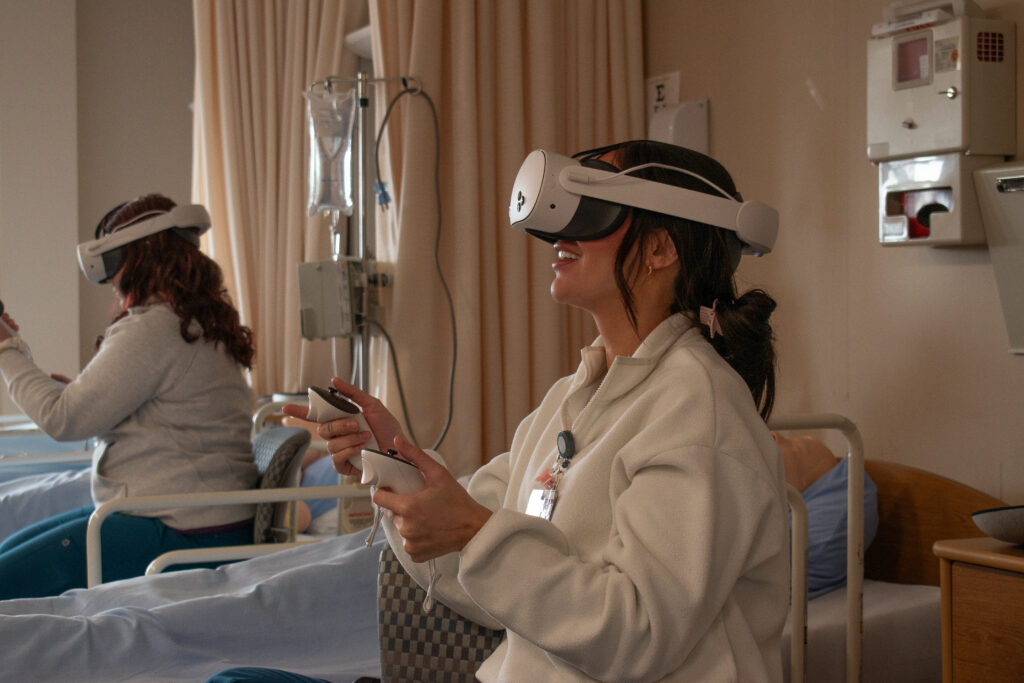
Nursing students using InvolveXR during NBCC's Pediatric Simulation Week.
This is the approach behind InvolveXR. Learners can complete simulations independently while receiving AI-supported assessment and debriefing, allowing programs to collect outcomes data without requiring faculty to facilitate every session. Because scenarios can be customized, the evidence generated reflects the curriculum and patient populations specific to each program, rather than a standard set of cases.
If your program is evaluating VR simulation for the first time, or reviewing your current approach, we’d be happy to discuss how to build an evidence strategy that supports your program.
Bring AI-Enabled Immersive Training to Your Healthcare Program
InvolveXR delivers simulation of real procedures and patient interactions with lifelike scenarios enhanced by AI.