
How Code Blue Simulation Enhances Critical Care Education
In: Clinical Simulation Scenarios
Code blue is a hospital emergency code. It signals that a patient is having a life-threatening medical emergency, usually cardiac arrest or respiratory failure. A code blue call means the medical team must respond right away for resuscitation. Code blue simulation training prepares healthcare teams to act with speed, skill, and confidence. In this blog, we will explore how code blue simulation training prepares healthcare teams to respond quickly and effectively. We’ll also look at different simulation methods, examples of scenarios, and how this training improves patient outcomes.
What Is Code Blue Simulation?
Code blue simulation refers to a training exercise that mimics a real hospital code blue emergency. For example, a patient in cardiopulmonary arrest requires immediate resuscitation. During a code blue simulation (often called a “mock code”), clinicians practice the entire continuum of a code blue response: - Recognizing a patient’s collapse - Calling for help - Performing high-quality CPR - Delivering defibrillation shocks for shockable rhythms - Managing the airway and medications - Coordinating roles among the team (such as team leader, compressor, ventilator, recorder, etc.).
This is typically done using a lifelike manikin or a virtual patient that can display vital signs and react to interventions. In-situ code blue simulations take place on the hospital ward or in the emergency department. They are often unannounced to test the team in their real work environment. These drills also check hospital systems, such as making sure the unit’s code cart is fully stocked.
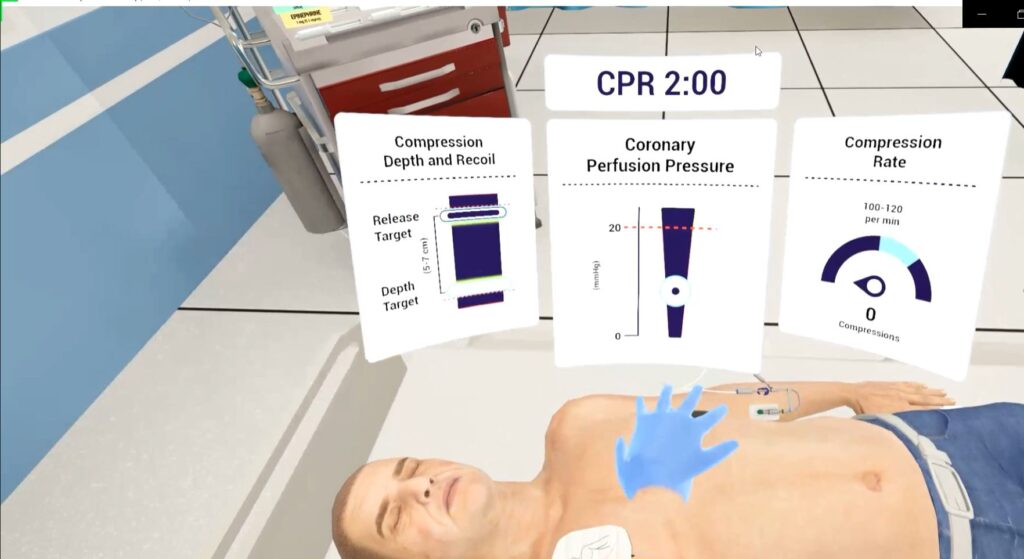
Lumeto provides immersive VR simulations that replicate the intensity of real emergencies. Trainees can practice CPR, airway management, and team coordination in a safe, controlled environment. Below is a screenshot from one of Lumeto’s code blue scenarios, where trainees monitor compression depth, rate, and coronary perfusion pressure while performing CPR:
Benefits of Code Blue Simulation in Critical Care
Code blue simulation training offers a wide array of benefits for critical care teams, learners, and institutions. Below are some of the key advantages of incorporating code blue simulations into critical care education:
Faster Response Times
Studies have found that teams that undergo mock code training respond more rapidly and effectively during actual cardiac arrests. For instance, one program reported that after simulation training, their providers significantly reduced the time from patient collapse to starting chest compressions and delivering the first defibrillation shock. Another study using repeated mock codes found that the interval from pulse loss to CPR initiation decreased from ~52 seconds to just 13 seconds on average. By drilling the algorithm and psychomotor skills, staff internalize the resuscitation sequence. They can perform it almost reflexively under stress. Even newly graduated nurses have shown increased speed to react and perform critical procedures after participating in regular code simulations. Nursing students at New York University are using Lumeto’s VR platform to rehearse high-emergency scenarios. The immersive environment allows them to rehearse life-saving actions repeatedly until a rapid, accurate response becomes second nature.
Greater Competence and Confidence
Healthcare providers often report feeling far more prepared to handle a real code after they’ve practiced in simulation. In fact, surveys consistently show that self-confidence in managing code blue situations increases significantly post-simulation. Frequent exposure to simulated crises helps clinicians overcome the initial shock factor of a code. They become comfortable with the algorithms, the equipment, and their role on the team. At Trillium Health, a Canadian hospital system, repeated code blue drills were introduced. Afterward, staff reported much higher confidence in recognizing arrest rhythms. They also felt more prepared to carry out interventions correctly. By training in a no-consequence setting, providers gain the assurance that they “know what to do” and can do it swiftly.
Enhanced Teamwork and Communication
During a mock code, team members practice communication and role clarity: - Who leads the code - Who handles the airway - Who pushes medications - Who records events, etc
With repetition, the chaos becomes more organized. Everyone learns to anticipate each other’s moves and speak the same “code language.” For example, the video below is from Lumeto’s virtual training scenarios. A medical trainee makes a dosage error. Another team member quickly notices it and corrects the action, keeping the code on track.
Exposure to Rare and Critical Scenarios
In critical care, some of the most dangerous events are fortunately rare. But that very rarity means staff may be unfamiliar or rusty in handling them. For example, pediatric cardiac arrests are relatively uncommon, so a nurse or doctor could go many years without ever participating in a pediatric code blue. Yet if that one pediatric arrest happens, they must perform flawlessly despite the rarity. With a code blue simulation, a pediatric code blue scenario can be staged so that providers gain experience and confidence in managing a child in arrest. They also practice handling differences in drug dosing and equipment. Lumeto offers customizable simulations that expose learners to these high-risk but rare events. Here are a few examples: - Septic Shock in the ER or ICU - Ectopic Pregnancy in the ER - PEA Arrest - Acute Papillary Muscle Rupture - Abdominal Sepsis - TIA Episode in the ER - Head Injury / Brain Bleed
Safe Learning Environment for Errors
Patient deaths are an unavoidable reality in medical training. For many learners, these experiences can lead to emotional distress and even a decline in empathy, which ultimately hurts learning outcomes. Simulation changes this. It lets clinicians learn from mistakes without dire consequences. If a resident pushes the wrong medication or a nurse intubates the esophagus instead of the trachea, the only “patient” at risk is a manikin or virtual avatar. Because there’s a virtual reset button, learners feel freer to engage and attempt interventions. They know they can repeat the scenario, correct errors, and steadily improve.
Realistic Code Blue Simulation Scenarios for Learners
Here are some examples of realistic code blue simulation scenarios commonly used for training:
Adult Cardiac Arrest Scenarios
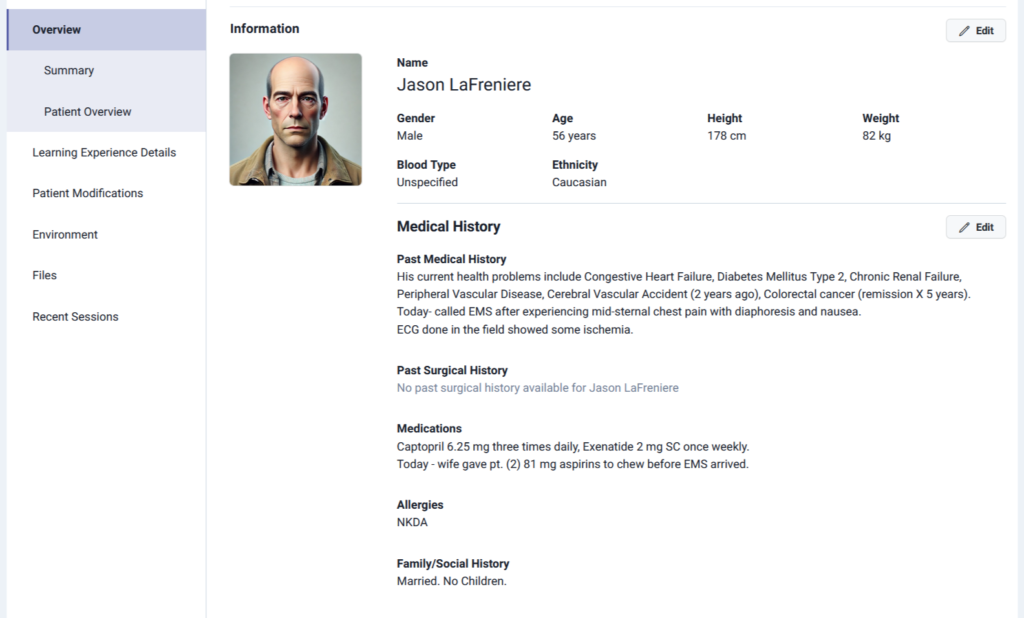
These form the bread-and-butter of code blue simulations in most hospitals. For instance, a scenario might involve a 60-year-old patient on a telemetry ward who suddenly becomes unresponsive and pulseless with a shockable rhythm (ventricular fibrillation). The team must recognize the arrest, call a code, initiate CPR, and go through the ACLS algorithm. On Lumeto, instructors can edit virtual patient details to make each scenario realistic and tailored to the learning objectives. For example, they can adjust: - Age and demographics - Medical history - Presenting complaint - Vital signs and ECG findings - Medications already given - Family or social history
Special Setting Scenarios
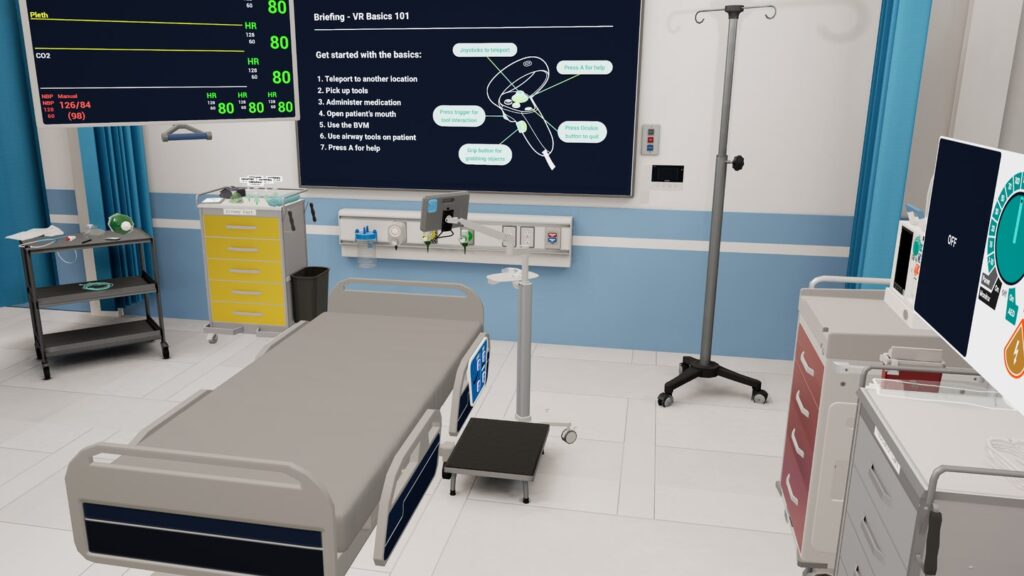
Critical arrests can occur outside the typical ward or ICU. High-fidelity simulations are often created for environments like the operating room (OR) or cardiac catheterization lab, where the setup and roles differ. For example, an OR code blue simulation might involve a surgical patient who goes into VF on the table. The scenario tests the coordination among anesthesia providers, surgeons, and nurses. These situations are tricky because not all code team resources are immediately on hand, and the environment might be cramped or unfamiliar to responders. With VR, recreating these settings becomes much easier. Lumeto allows instructors to change the environment and modify available medications. The platform includes over 200 interactive medical equipment items.
Pediatric Code Blue Simulation
Pediatric code blue simulations matter because children present very different challenges from adults. A realistic case might involve a toddler on a pediatric ward who goes into respiratory arrest from severe asthma. The scenario can also introduce common stressors. For example, a panicked parent might be present, or the team may struggle with IV/IO access, which is often harder in children. At one tertiary care hospital, 74% of graduating pediatric residents had never led a real resuscitation during their residency. That means their first leadership experience could be after training, if not for simulation. To address this, pediatric and neonatal training programs heavily use simulation to give residents and fellows a chance to “run the code” in practice.
With Lumeto, these elements are easier to include. The platform allows instructors to add non-patient characters, such as distressed family members, to create a more lifelike and stressful environment for learners. Here’s an example:
Code Blue vs. ACLS Simulation Training
ACLS training is a formal certification course (designed by the American Heart Association in North America, and similarly by resuscitation councils elsewhere) that teaches healthcare providers the standardized algorithms for managing cardiac arrest and other cardiovascular emergencies. Code blue simulation, on the other hand, is a broader term that refers to any simulation of a cardiac arrest scenario, typically in the context of a hospital “code blue” team response.
| Aspect | ACLS Simulation Training | Code Blue Simulation |
|---|---|---|
| Purpose | Certification and skills check | Team practice and system readiness |
| Focus | Algorithm, rhythms, meds, airway | Full code process, team roles, hospital workflow |
| Format | Structured, scripted, time-limited | Flexible, realistic, and can be unannounced |
| Context | Standardized (AHA/global protocols) | Customized to hospital policies, settings, and drugs |
| Scenarios | VF, PEA, asystole, VTach | Cardiac arrest plus stroke, anaphylaxis, and respiratory arrest |
Types of Code Blue Drills
Code blue simulations are not all run the same way. As covered above, in-situ drills can be unannounced to test a team in its real environment. Here is a fuller breakdown of the three drill types most programs use, and when to reach for each one.
Announced drills. The unit knows the date, and sometimes the scenario. These work well for teaching a new protocol or onboarding new hires before testing them under pressure. Nobody should learn a new sequence for the first time during a surprise.
Unannounced mock codes. No warning, run during a normal shift. Sometimes called mock drills, these surface the problems a drill exists to find: real response times, equipment gaps, and communication breakdowns that don’t show up when people know it’s coming.
Scenario-specific drills. Built around a known weak point rather than a generic arrest, such as a pediatric code on an adult ward, an arrest in radiology or an elevator, or a known difficult airway. The adult, special-setting, and pediatric scenarios described above are exactly this kind of drill scenario: cases worth repeating on a schedule because they rehearse the situations a unit sees rarely and manages worst.
Writing enough scenario variation to keep drills from feeling repetitive is real work, which is one reason editing an existing virtual patient (age, rhythm, comorbidities, setting), as described above, matters as much for drill programs as it does for lab teaching.
A mature program rotates all three types: announced drills establish the baseline, unannounced ones test whether it holds under real conditions, and scenario-specific drills cover the low-frequency, high-risk cases a generic rotation would never happen to catch.
Debriefing a Code Blue Drill
None of the benefits above happen automatically. They depend on what happens after the drill ends, and that’s the step most programs cut for time.
A drill that ends the moment the “patient” is resuscitated has tested the system and taught almost nothing on its own. The debrief is what turns a logistics exercise into code blue education. Compressing it into “good job, any questions” wastes the effort that went into running the drill in the first place.
A structured debrief has four stages. None should be skipped, and the order matters.
1. Reactions. Before any analysis, let the team say how it felt. This is not optional politeness. A team still processing adrenaline from a stressful unannounced drill will not hear feedback accurately until that’s acknowledged. Two or three minutes, no interruption.
2. Timeline reconstruction. Rebuild what actually happened, in order, without judgment yet. When was the code called. When did the first responder arrive. When did compressions start. When was the first shock delivered, and at what interval. Build this from what people observed, not from what they assume happened, because those two diverge more often than teams expect.
3. Gap analysis. Compare the reconstructed timeline against the ACLS algorithm and the unit’s own protocol, and name where the two diverge. This step needs a facilitator who knows the algorithm cold, because a gap analysis run by someone unsure of the standard feels thorough and teaches nothing precise. Name the gap, not the person. “Compressions paused during rhythm check longer than the algorithm allows” is useful; naming an individual is not, and it’s the fastest way to make a team stop being honest next time.
4. Transfer. End with one specific thing the team will do differently on a real arrest, not three things and not “communicate better.” One concrete, observable change, such as the compressor calling out the time so the switch happens on schedule. A debrief that ends without a transfer step is a conversation. One that ends with one is training.
Debriefs go worse when run somewhere other than where the drill happened, when the most senior person in the room dominates the reconstruction step, or when the debrief is treated as optional because the drill ran long, which is exactly the drill where it matters most.
The timeline step is also where a recorded run helps most. In a physical mock code, it depends entirely on what people remember and are willing to say happened, which is exactly where disagreement shows up. On Lumeto, a recorded virtual run makes the timeline retrievable rather than argued from memory, so the team can watch the sequence back instead of reconstructing it from four accounts of the same two minutes.
Crash Cart and Equipment Readiness
The intro above mentions that in-situ drills check hospital systems, including making sure the unit’s code cart is fully stocked. That single check is worth unpacking, because a code blue drill is often the only time a crash cart gets tested under real conditions instead of a checklist tick.
Most units check the crash cart on a schedule: contents against a checklist, expiry dates, battery charge, seal integrity. That confirms the cart is stocked. It doesn’t confirm the cart is usable in an actual code.
A drill tests what a static checklist can’t: whether the cart is where the team expects it, whether the first responder can find the airway kit without hunting, whether the defibrillator is the model staff trained on, and whether the path to a patient room is clear or blocked.
Capture these findings on the drill’s own checklist, separate from the clinical debrief: cart location and access time, equipment missing or unfamiliar, and anything that slowed the response. Route it to whoever owns crash cart stocking and unit layout, not only into the educator’s notes.
Drill Cadence and What to Measure
The scheduling difficulty described below (pulling staff off the floor, the risk of running too often or too rarely) is real, but it leaves open the actual question: how often should a unit run these, and how do you know if the program is working?
Cadence needs to fit the unit. High-acuity areas such as ICU, ED, and PACU tend to run drills more often, sometimes monthly; general floors more commonly land on a quarterly cadence.
What to measure, per drill, so the program can show whether it’s working and not just whether it’s happening:
- Response time, from code call to first responder, and to full team assembled.
- Crash cart access time and equipment gaps, tracked separately from the clinical debrief.
- Time to first intervention (first compressions or first shock) relative to the code call.
- Debrief completion. A drill without a debrief shouldn’t count as complete.
- Repeat findings across drills. The same gap on consecutive drills is a system problem, not a coincidence, and it’s the strongest argument for getting resources to fix it.
None of these numbers matter in isolation. What they show is a trend: is response time improving, is the same gap recurring, are transfer items actually changing behavior. A program that tracks this consistently has a case for its own budget, the same way a structured, checklist-based approach pays off in OSCE assessment.
Challenges and Limitations of Code Blue Training
Here are some of the key challenges in code blue training, along with inherent limitations of simulation to be aware of:
Time and Scheduling Constraints
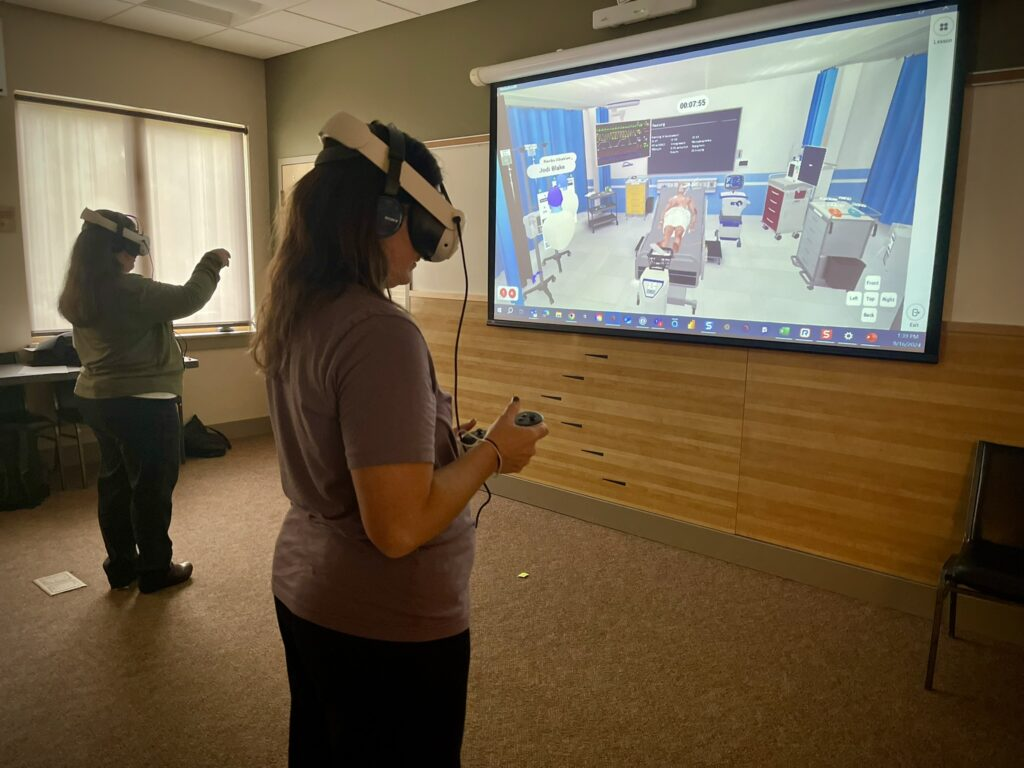
Healthcare staff have busy schedules due to clinical duties and round-the-clock patient care responsibilities. Pulling nurses and doctors off the floor for training can be difficult, especially in understaffed units. Many hospitals struggle with clinicians missing sessions due to urgent patient needs. If simulations are too infrequent, skills may degrade between sessions; if too frequent, they may disrupt workflow or face poor attendance. Some hospitals run “pop-up” mock codes that are brief and don’t require everyone’s presence simultaneously, or use simulations during night shifts when feasible to reach those staff. Even so, time is a perennial limitation. This is where innovative solutions like VR can help: VR training modules can be run individually by staff during downtime or night shifts. For example, Lumeto’s platform allows asynchronous training. A clinician can put on a VR headset and run through a code scenario on their own. If they miss the group mock code, they can still practice and avoid scheduling conflicts.
Leadership Support
Successful code blue training programs need strong support from hospital leadership. Without it, programs might falter due to lack of resources or priority. Some barriers come from perception and resources rather than resistance. For example, hospital leadership may feel that existing compliance measures, such as ACLS certification, already cover resuscitation training. The added benefits of ongoing simulation may not always be clear at first. Educators and trainers also face challenges when adopting advanced simulation technologies like VR systems. These difficulties can include: - Limited prior experience with immersive technologies - Concerns about setup time and technical troubleshooting - Difficulty aligning VR scenarios with existing curricula - Uncertainty about measuring learning outcomes in a virtual setting - Limited staff bandwidth for learning new platforms
Lumeto offers a Train the Trainers program to support educators in gaining confidence with VR-based simulation. We provide hands-on guidance so trainers can run sessions smoothly and focus on teaching instead of tech setup. We also help institutions integrate VR systems into their existing curriculum. The scenarios are designed to align with ACLS requirements as well as hospital-specific protocols.
Financial and Resource Limitations
Code blue simulations, particularly high-fidelity ones, can be resource-intensive. High-fidelity manikins that support ACLS scenarios are expensive (often costing tens of thousands of dollars). They also require upkeep and staff training to use. Simulation labs need space and often dedicated staff (simulation educators or technicians) to run scenarios and maintain equipment. Not all hospitals, especially smaller or resource-strapped ones, can afford a full sim center. In some cases, training gets cut from the budget if the return on investment isn’t immediately obvious. Increasingly, virtual simulation is emerging as a cost-effective alternative. There is an upfront cost for VR equipment and software. But scaling it to many learners is relatively low-cost. It is often cheaper than buying multiple advanced manikins or building dedicated labs. VR doesn’t require physical space or as many staff to run; one educator can supervise multiple VR learners remotely. Lumeto’s AI-powered Artificial Clinical Evaluator (ACE) can even conduct parts of the evaluation automatically. Here’s an example from the instructor’s dashboard:

How Lumeto Brings Code Blue Simulation to Life
Lumeto’s InvolveXR gives hospitals a full code blue training lab that runs on demand and captures hard data you can use. - AI patients that talk and react: Learners engage with lifelike virtual patients who show facial expressions, respond to voice, and react in real time to clinical decisions.
- Customize without writing code: Educators tailor cases to local protocols (ERC/AHA), meds, equipment, and team roles with no-code editing.
- Screen mode: A headset-free, on-screen option allows classroom run-throughs or remote refreshers, widening access and cutting scheduling friction.
- Ready-to-run scenarios: Staff can step into 800+ customizable scenarios anytime and practice until they get it right.
- Adaptive Scenario Difficulty: Scenarios can scale in complexity. For beginners, Lumeto can script a straightforward VF arrest; for advanced clinicians, the same case can include complicating factors.
Here’s how instructors can change the scenario in Lumeto on the go:
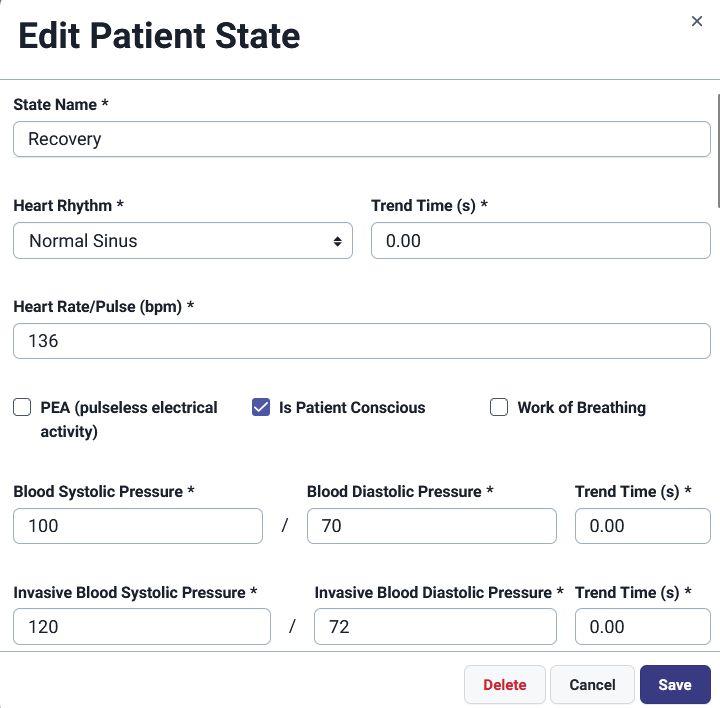
With InvolveXR, code blue simulations are accessible on demand and easy to set up. Teams can train together in VR or use screen mode for classroom refreshers. Book a demo today to see how InvolveXR fits into your training program.
Frequently Asked Questions
Do Code Blue simulations actually improve patient outcomes?
Yes. Research shows that mock codes lead to faster CPR and defibrillation in real arrests, fewer errors, and higher survival rates. Teams also report more confidence and better teamwork.
How do pediatric Code Blue simulations differ from adult ones?
Pediatric simulation scenarios focus on unique challenges like airway size, weight-based drug dosing, and the emotional stress of treating children.
Can simulation training reduce stress during real codes?
Repeated exposure to high-risk scenarios through simulation helps staff act reflexively, lowering anxiety and hesitation when facing real emergencies.
What is a Code Blue drill?
A code blue drill is a rehearsal of a hospital’s cardiac arrest response, run on a real unit with a manikin or virtual patient standing in for the patient. It tests the system: whether the crash cart is stocked and reachable, who responds and how fast, and whether the unit’s layout slows the team down.
What’s the difference between a Code Blue drill and a Code Blue simulation?
A drill runs in the clinical environment and tests logistics. A simulation runs in a lab or virtually and tests clinical management of the arrest itself. The drill finds the logistical failures; the simulation builds the clinical competence. Most programs need both.
How often should a hospital run Code Blue drills?
Cadence depends on acuity. High-acuity areas like ICU, ED, and PACU often run monthly; general floors more commonly land on a quarterly schedule. The limiting factor is usually the time to prepare a credible scenario and find a slot when enough of the team is on shift.
Should Code Blue drills be announced or unannounced?
Both have a role. Announced drills suit teaching a new protocol or onboarding staff, since the goal is correct sequence. Unannounced mock codes surface real response times and equipment gaps, since they run under real conditions. A mature program uses both.
What should a Code Blue drill debrief cover?
Four stages: reactions, letting the team process before analysis; timeline reconstruction, rebuilding what happened in order; gap analysis against the ACLS algorithm and unit protocol; and transfer, naming one specific change for a real arrest. Skipping the debrief is the most common way a program loses its own value.
How is crash cart readiness tested in a drill, versus a routine check?
A routine check confirms the cart is stocked against a checklist. A drill tests whether it’s actually usable: whether it’s in its expected location, whether the first responder can find equipment without hunting, and whether the path to a patient room is clear. Only a drill catches that second kind of failure.